Monday, September 24, 2007

SW Australia - 1

September 15

Got to Perth soon after breakfast, Saturday. Gathered our bags, said our goodbyes, and boarded a tour bus. We had also arranged for the bus to deliver us to the Britz campervan rental after the tour.

Cold, windy day in Perth. Bus driver said they’re predicting a week of more of the same. Hope not. As we drove around city, bus driver primarily pointed out fast-rising real estate prices – these people bought for $400,000, sold a year later for $900,000. That sort of thing. Perth is booming; more jobs than they have people.

The only place we got out of the bus was King’s Park, very large park adjoining downtown Perth. Got a couple wildflower shots in case we strike out later (which we mostly did -- a few weeks early for the part of west Oz we went to).


Got to the campervan rental place and got signed in and checked out by about 230pm. Fortunately, for getting accustomed to driving on the left, we were on edge of town and had two easy left turns to get on the road toward Albany, our S coast destination, about 250 miles away. Four lanes to start out with. I got in the left lane and stayed in it until we stopped for lunch. Spotted a Subway in a shopping Center. Made a right turn into parking lot OK, but in wandering around to find a place to park managed to hit two curbs with left rear tire.

On the highway I sort of drove by feel. You/I have a tendency to drive too far to the left when the steering wheel is on the right, so, too frequently, I’d drift left onto the rumble strips adjacent to the left shoulder. Particularly when meeting vehicles on a fairly narrow road. Never caused Dick to scream, however, (as I did when Susie took a practice drive down a country road in New Zealand) so it could have been worse.

After 150 miles or so, it was getting dark, so we decided to stop at “caravan park” in a little country town called Kojonup. A lot of place names in this area end in “up.” Need to lookup why. Made a grocery run to the local Cal-Tex service station and mini-mart, had dinner at a hamburger joint called the Hard Work CafĂ©, and got the camper set up for sleeping. Had a momentary panic because we couldn’t find electrical outlet at first, but night went well.


Next morning, blessed by clear skies, we drove on to Albany (pronounced OWL-bun-nee). Stopped for pictures of sheep pastures and canola fields – yellow flowers at this stage. Need to find out about canola farming, because it’s big here. A sign entering the shire(county) claimed one million sheep for the region.


In Albany we spent some frustrating time on the internet: couldn’t do a reply or forward with e-mail; couldn’t do any blog-posting because the Blogger website came up in Chinese and I couldn’t find the way to change it. Assuaged the hurt, though, with a nice fishandchips lunch.

Albany is historically important because in 1826 the governor of New South Wales – Sydney and its surroundings – sent a ship over there to claim the region and hence the whole continent for England – keeping the pesky French out. The ship that landed there, the Amity, has been restored and is available for touring. A load of convicts settled here to launch the occupation.

A long arm of land extends south of Albany and we drove out there to see the rugged coast and the wave action on it. Very awesome!


Now you see him. Now you don’t.


Another stop was Whale World, a whaling station converted into a museum. The Albany Whaling Station was Australia’s last, closing in 1978. Our guide told us, though, and this was surprising to me, that whale-watching is a bigger business than whale-killing and processing ever was.


Getting to be late afternoon, now; we drove west to the next town, Denmark, found a caravan park (see below), had dinner, and called it a day. It was one of the best dinners I’ve had on the trip. Chef was grilling on the barbie. Pick your meat and he’d fix it. It wasn’t on the menu, but when I requested it he did me some shrimp on the barbie. Outstanding. Dick chose a seafood platter that had a large helping of squid – like chewing a bicycle inner tube.

Tomorrow the big trees and forest walk in the sky.

Cheers,

Rob

Maureen & Justin

Friday, Sept. 14, I went down to the lounge car to read. Nice lady sits down by me. Out of all the lounge cars in all the trains in all the world, she picked mine. Says her name is Maureen, from Sydney. I say, Hello, Maureen. That’s a nice name. We talk.

Turns out she spent 13 years in the US, teaching in the South Bronx (after a teaching career in Australia – went to NY on a lark). At age 70 she came back to Sydney in 1999 because she’d always planned to retire there. Besides, the only way to retire in New York is to have money, which she didn’t.

In NY she says she taught English and History to adults who had to have these courses in able to stay on Social Security. This requirement is news to me, but I didn’t question her about it. She might have meant citizenship requirements.

Aussie authors she likes? The poets, like Banjo Patterson. They understood what it meant to be Australian. They told the stories.

Australia is losing its character. What’s that? I ask. “Mateship,” is her answer. We’ve lost our mateship. This means the unquestioning willingness displayed by bush-people to help anyone who needs help, whenever, whatever the circumstances, rich or poor, black or white. Knowing you could rely on your mates was the difference between survival or not.

In Australia, did she teach Australian history? Oh, No. Nobody teaches Aussie history and it’s a shame. They teach English history. They seemed embarrassed to teach about the convicts who were forcibly settled in Australia. Those convicts did marvelous things. An example: Sydney Hospital was built by convicts. They were paid in rum, so it’s called the Rum Hospital. (By the by, Adelaide is an exception – not settled by convicts.)

We got off on the topic of remembering people’s names. She had a tough time remembering people she’s met on the train. I’m no better. We decided it’s rude to be introduced to someone and then not be able to call them by name a little later. We rehearsed the names of people she had met and that I could identify.

Time zones were a problem. Sydney is on Eastern time. Adelaide is on Central time, which is one-half hour earlier. Western Australia is on Western time, another hour and a half earlier! The train, however, keeps its own clock – doesn’t change time at a border crossing, but makes a change in conjunction with a particular stop. So, today’s dinner time and our subsequent time for stopping in Kalgoorlie were confusing. Either we were having an unusually early dinner or a late stop at Kalgoorlie. I never did come up with a good explanation.

At dinner a little later I sat with Maureen, Don (from Calgary), and Justin – a young man who got on in Adelaide. He is a lawyer in Perth, was returning from a holiday trip to the US and UK, had bought a car in Adelaide, and was shipping it to Perth via the IndianPacific. So, that’s why he was on the train. He hadn’t enjoyed his first 24 hrs. – for one thing he was a smoker and you can’t smoke on the train. Two stops a day are not enough. But, he entertained us greatly with his story.

His home is the UK where he got a law degree and went to work in a bank. One day, he said, This is boring, and he quit. Found a job as a policeman in Queensland, Australia – NE corner of the country. Subsequently applied and got a lawyer job in the district prosecutor’s office, then did the same when he saw similar job advertised in Perth. It’s a formal court system here – he wears a wig in court.

Maureen told Justin he was too angelic to be a lawyer. He said that helps him with witnesses and juries.

Somehow the topic of boring jobs led him to tell of a friend who did a PhD thesis on grain transportation in ancient Egypt. Justin asked him what he learned. Answer: They used donkeys. That’s it! Two years of work and it comes down to this.

Also learned from Don at dinner that his son plays underwater hockey. Never heard of it – have you? Invented in Canada, no doubt. They actually have international tournaments and he’s on a team in Perth.

Here’s an end-of-the-trip of Maureen and Dick.


Cheers,

Rob

Pudd'nhead Wilson

PuddnHead Wilson

First book on my Paul Theroux reading list is Pudd’nhead Wilson, by Mark Twain. I read it on the train. A real gem; sorry I’ve just now read it; glad I was pointed to it.

I won’t spoil things by telling you as much of the plot as the author of the Introduction did (once again I pledge never again to read an Introduction until I have to), but here’s the basics: Two baby boys are born into the same household at about the same time. They look very much alike, but one has 1/32 “Negro” blood and is therefore a slave; the other is (fully) white. They are both raised by the same woman – nanny for one, mother of the other – and she’s the only one that can tell them apart. You can see the possibilities.

Twain tells the story with humor and sarcasm, exposing some of mankind’s lowest and highest characteristics. There’s slapstick comedy and courtroom drama. Many twists and turns like a drawing-room comedy. All in 139 paperback pages.

Pudd’nhead gets his name as follows (if you don’t want to know, scroll down somewhere now): He comes to Dawson’s Landing, on the Mississippi below St. Louis, to establish a law practice. On his first day in town, while meeting with some residents, he hears a dog barking in a disagreeable way and says, “I wish I owned half of that dog.” Why? “Because I would kill my half.” This makes no sense to the townspeople and he is promptly labeled a fool, a perfect jackass, and dubbed Pudd’nhead.

Wilson is writing a calendar-based almanac of wise and witty sayings and Twain introduces each chapter with one or more. Here’s my favorite:

July 4. Statistics show that we lose more fools on this day than on all the other days of the year put together. This proves, by the number left in stock, that one Fourth of July per year is now inadequate, the country has grown so.

More seriously:

Let us endeavor so to live that when we come to die even the undertaker will be sorry.

Pudd’nhead was published in 1894, about a decade after Tom Sawyer and Huckleberry Finn were published. Like those books, Twain creatively writes “slave dialect” that is entertaining to read and I presume accurate. An example:

“De angels is gwine to’mire you jest as much as dey does yo mammy. Ain’t gwine to have ‘em puttin’ dey han’s up ‘fo dey eyes en sayin’ to David en Goliah en dem yuther prophets, ‘Dat chile is dress’ too delicate fo’ dis place.”

Anyhow, great book, fun read.

Cheers,

Rob

Monday, September 17, 2007

IndianPacific - 3

Friday, Sept. 14

Much of today is to be spent crossing the “nullarbor”(treeless plain, pronounced NULL-uh-ber) featuring nearly 300 miles of perfectly straight track. Before that, I thought I’d tell you about our accommodations.


The single sleeper-cabins are wedge-shaped, successive pairs of cabins being mirror images – wide ends abutting, narrow ends abutting. There are two rows of cabins, offset so the wide ends of the wedges on one side are opposite the narrow ends on the other. The car has 18 cabins and two toilets at one end, two showers at the other. With this layout, the center hallway undulates like a snake, or a sine-wave, depending on your preferred image. Hadn’t ever seen that in the movies – where my train knowledge comes from.


The double cabins in other cars are rectangular, along only one side of the car, and the aisle squeezes along one side. This is the layout I’ve seen in train-movie comedies or murder mysteries as characters careen or sneak in and out of various compartments. I can’t recall the movie, but I remember Cary Grant landing in some lovely lady’s cabin and arms in such circumstances.


The wide end of a cabin includes a sink/vanity; the narrow one has a six-inch wide closet. There’s a cushioned chair, a fold-down writing table, and a footstool all along the outside wall. All this folds out of the way when the bed is folded down out of the wall by the “staff.”


At mealtimes – four “bachelors” have gravitated to sit together: Don, from Calgary; Dennis, from Sydney; Dick, and I. Almost everybody else is husband-wife couples, mostly pensioner age plus some. Dennis, who runs a limo service in Sydney and is somewhat younger than the other three of us, is riding the train to Perth to see his sister. This is the second time he has taken the train to visit her. Why? we ask. Says he’s hoping to find romance. Not much chance in the Gold Kangaroo class. Maybe he should try coach next time! Anyhow, Dennis is helpful in explaining Australia to us. For example, he says Australia is the only country whose coat of arms features two animals used for food – kangaroos and emus. He’s also a vegemite guru. We try to get Dick to put some on his toast, but we’ve said enough bad things about it, that there’s no way. Dennis said he quit eating vegemite when they sold out to Kraft. No longer an Aussie product – he’s boycotting.


Don, from Canada, not to be confused with Don from Sydney, is on his way to Perth to visit his son. As we did, he spent a few days in Sydney and chose the train to cross the country. From Perth, he, his son, and his son’s girlfriend are going to explore some of the SW coast as are we.


OK, back to the scenery. Here’s what the nullarbor looks like. That's a RR maintenance road along the track in the foreground.

Our stop in the morning is at Cook. Cook once featured a school and a hospital, but now is a ghost town with a population of two people – a caretaker and his wife. This is a stop for “watering up” the train and for a crew change. Two new “drivers” get on; two get off and catch the next train which is, or will take them to, their next assignment. I take it there are accommodations for waiting crews – they don’t sit by the track with their bags.


A fellow passenger and I took each other's pictures by the engine.


At Cook, we’re near the midpoint of 477 kms (almost 300 miles) of straight track – the world’s longest. This is what we came to see!


Two or three hours after we leave Cook we leave the nullarbor. Here’s a picture of that. Oh, wait. That’s the same as the picture above. Close enough, though.

We’ll be in Kalgoorlie this evening for our next stop. Hope to get internet access there and post some of information the world is waiting for. I know people at home are anxiously checking their computers, waiting for word from the Reinert/Easterling expedition, like waiting for Lindbergh’s radio signal.


In Kalgoorlie we take a bus tour by dark to see the huge pit gold mine, houses, government buildings, and businesses. After that Dick and I walk back to one of the pubs that we’ve been told has internet. It does, but we need change to operate it. Trouble is, the bar is crammed with people watching a football playoff game (Australian rules). Can’t get up to the bar to get change and we’re running out of time (toot, toot! not really) so we’re not successful. I do manage to call Susie to let her know where we are.


Tomorrow it’s Perth where we’ll pick up a camper van and head south, driving on the wrong side of the road. Wish us luck.


Cheers,

Rob

IndianPacific - 2

Thursday, Sept 13

I arise early, as is my wont, and head down to the lounge car about 5:30. Here’s a sunrise picture.

Train staff are going to serve a pre-breakfast at 6:00 because we’re stopping for our first “whistlestop” tour – this one in Broken Hill – at 7:00. There are a couple of Aussie old bulls in the lounge and the talk soon turns to politics. After finding that I’m from USA, they give me a primer:


There is soon to be an election for prime minister and the incumbent, John Howard, of the Liberal party (which is Australia’s conservative party – go figure) is trailing badly in the polls to his Labor Party opponent. A lot of what I hear is “grrrrrr, bloke, grrr bloody, grr, hmmph, youknowwhatImean,” but some of the points I pick up are: Labour can’t manage the economy. Last time they were in their Treasurer was a bloke who had managed three coffee shops into bankruptcy – and he was put in charge of the country’s money!! The public’s memory is short, they say. Howard has been in about 11 years, and people have forgotten how bad the economy was before then and what the Liberals have done since then to fix it. There’s a whole new generation of voters, too young to remember and too uninterested to care. (Incidentally, Don told us that if you don’t register to vote, or if you don’t vote, you’re fined. Everyone is required to vote. I need to look up some statistics on that. Where’s the internet when you need it?)


Australia’s big trading partners in Asia had disastrous stock-market crashes a few years ago, but Australia was largely cushioned from the blow, thanks, I’m told, to people who understand how the economy works. Everyone in Labor’s leadership is a union member and they can’t manage anything – like coffee shops! (I pick up a paper later in the day and the Liberal Party’s number two man is cited as saying: ‘(the) Opposition Leader (is) an economic illiterate backed by a “gaggle of trade union leaders.”… “the most lightweight leader of a political party that I have seen.”’ Nothing like being forthright.)


I think Howard’s been our best ally in thinking clearly and speaking coherently about the radical Islam threat, so it will hurt to lose him from the world scene. Australia has 550 troops in Iraq The Labor leader’s plan is to bring them home at a rate of 10-15 per month. You can’t do that, my instructors say. They’re a unit. To dismantle them slowly is going to leave a body that can’t function as a unit. It puts comrades at risk.


Anyhow, I enjoyed my instruction in Aussie politics from the Liberal side.


Broken Hill, well into the outback, came into existence when silver was discovered in 1883. They’re still actively mining silver, lead, and zinc and the town’s population is 23,000. Our tour bus driver estimated that BH had another 100 years of mining left, others are more pessimistic. There’s an underground ore seam 4.5 miles long by about 800 ft. wide (he didn’t say how thick) -- they call it the line of life (which is how I translate the “loin of loife”) -- that’s being extracted.


Our first stop is the airport where a unit of the Royal Flying Doctor Service is located. On the way we pass under a sign that says Airport, our driver points out. It used to say Welcome on one side, Farewell on the other. That was for Queen Elizabeth’s benefit, who visited quite a while ago, but now it just says Airport. Makes you kind of sad.


As we drive around town, our driver helpfully points out several retirement homes. I guess he’s made a judgment about the interests of the IP passengers he sees on his bus. BH has lots of well-kept miner’s cottages and a nice downtown collection of 100-year old public buildings, so I can see why BH could be something of a tourist destination. A town brochure lists several B&Bs.


W.r.t. the Flying Doctors, there are 22 such installations covering 80% of Australia to the extent that anybody anywhere in that vast open expanse who needs a doctor can be reached within two hours. Also, the service has scattered medicine chests around the country for ready access. Also, people in the outback have body maps, so someone in pain can tell the doctor by phone or radio, “It hurts between my A and my B! Nobody pays for service – government pays 2/3 of the program’s cost; various citizen fund-raising activities -- rodeos, bake sales, … -- pay for the rest.

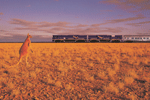
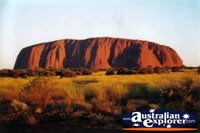
One other stop on the tour was a combination art gallery and jewelry store. I bought a postcard copy of a local artist’s rendition of the Red Centre. Here’s a picture of it (guess I could have just photographed it in the store and saved $1):

Somewhere out of Broken Hill Dick sees a couple of kangaroos in the real wild. I’m on the other side of the car with my nose to the laptop, so I don’t see them. Later, while we’re stopped on a siding, Dick sees an emu hen(?) with five chicks near by and I get a good look through binoculars.

Around Broken Hill the terrain is quite barren. Later, around lunch time as we angle southward toward Adelaide we get into wheat-farming country – pretty and green.


In Adelaide the weather has turned rainy. We take a bus tour with only one brief stop to get out. The original city is surrounded by parkland on four sides and the city is known for its gardens. We get some glimpses through wet windows. We also see a lot of small to elaborate period homes, well-preserved or restored. Adelaide is known as the “city of churches,” and we drive by quite a few fine old specimens.


My big thrill is that the bus went by the Newmarket Hotel where my Mom and I memorably stayed in 1991. It looks like it’s been refurbished. A lounge is prominently advertised. The surrounding neighborhood looks friendlier. (I had thought about skipping the tour and making a pilgrimage to the Newmarket on my own, but I had decided seeing the city that Mom and I didn’t was the better choice.) Later I talked to bus driver and he confirmed my impression that the Newmarket is surviving and thriving.


We leave Adelaide about dark.


Cheers,


Rob

IndianPacific - 1

Wednesday, Sept. 12, after our meat-pie lunch at the Lord Nelson we take a cab to Central Station and find the platform for the IP, if I may abbreviate it that way. We’ve been concerned because the directions we received said take only a small bag on board; have large bags shipped on the baggage car, with no access until Perth. The IP folks on site tell us, though, that if you’re going to Perth, you’ll probably need all your stuff in your compartment with you – and there’s room for what we have. I had packed with the idea that I would have only my small bag, but was glad, nevertheless, to take them both on board. The compartment is small, but with enough room for me and the two bags.

We’re also told when we board to wait in our cabins until our “car-manager” comes by to instruct us on safety and other essentials. I get my lecture, but Dick doesn’t. He can’t leave his cabin, just down the row from mine. I go find the car-manager and she comes to instruct and free him. Part of the process is to give our meal-sitting preference – early or late. We wanted early, but those slots were filled before they got to us. Late dinner is 8:00pm, but when you consider that they fold your bed down while you’re at dinner, maybe it’s better to eat later.


Anyhow, when we get back from dinner, my bunk is down and apparently so are the others in the car, but Dick’s isn’t. He’s starting to think they’re picking on him and is about ready to push the emergency button, which we’ve been told is a no-no except in life-threatening circumstances, to get some attention. (Not really – Dick wouldn’t do that.) He finds the staff and they rush to take care of him.


At dinner we sat with Don. Don was traveling from Sydney, his home, to Adelaide to see his brother and sister who he hasn’t seen for 40 years. Dining car was very noisy and Don’s voice was soft and his accent was pretty thick, so I didn’t get a lot of this directly, but Dick and I discussed it afterwards, so I think this is the story.

Don volunteered to fight in Vietnam against his family’s wishes. They turned their back on him. When he came back, he got the sort of abuse from his fellow citizens that many Vietnam vets got, here as well as the US. All very traumatic, but after 40 years he’s going to try to reconnect with his family. Hope he is successful.


One other thing: Dick like milk with his meals. He makes the request; some times they bring milk. Still picking on him.


Full train day tomorrow. Stay tuned.


Cheers,

Rob

Sydney -day 4

Sept. 12. Sydney, Day 4

We leave this afternoon on the Indian Pacific train. But first: I wake up early. The Harbour Bridge beckons. I decide to walk across it and back and am rewarded with this view of the Opera House from the Bridge at 530am.

From one end of the walkway to the other is about 20 mins.

I’m fascinated by the Bridge. That’s the Sydney icon for me. As Bryson notes, it’s always popping up in your line of sight – above a leafy residential street, over the top of low buildings, end of busy avenue, as a ferry rounds a point, … It’s known affectionately as the “coat hanger,” and you can see why. Its magnitude - the massiveness of the pylons and girders - relative to a fairly short harbour-crossing makes it stand out. It’s not one of those wispy modern bridges you see – the ones that impress you with their apparent lightness and hide their real strength.

This bridge carries 10 lanes of traffic, I think, plus a light-rail line, and a pedestrian lane on one side, bike lane on other side.


This is our last morning in the Lord Nelson. We do both breakfast and lunch there – finally have a meat pie. Quite meaty and well-spiced. In between we manage to use our phone card successfully – repeated failures the day before, at a cost of AU50c each! The card, though, is phenomenal once you get connected – 300 mins. for US$8. Good to talk to the folks at home. We also check e-mail and I blog-post our Sydney notes and pictures for your edification and pleasure. [Note added later. A week later we - Dick, actually - get the idea to call the card's customer service number. Turns out we've been interpreting things wrong. The card has access numbers listed by cities. That means use them only in those cities. We've been using the access number of the nearest city when we've been out in the bush. Wrong. That requires more money in the machine for a long distance call. We've been putting in 50c, as in Sydney, so, boom, when that's spent the line is disconnected. There's another access number for calls outside the listed cities. So, as of today, 9/18, we're using the phone card correctly. I think we're paying more for it, though, when we have to use the national number. But, it's worth it to hear the voices of all of you to whom we have been fortunate enough to speak.]


Across the way from the Lord Nelson is a historical observatory, now a museum, and we spend an hour there. Lots of telescopes and associated gear plus a very interesting video is playing on the voyage of James Cook that led to the discovery of Australia. His reason for being in the south Pacific was to observe the “transit of Venus.” That’s when Venus passes in front of the sun, from the right perspective on earth. This happens twice in an eight-year span about once a century. I don’t have even a glimmer of the mathematics/geometry involved, but by measuring this transit it’s possible to get an accurate estimate of the distance from the sun to the earth and from that be able to measure distances among the other planets more accurately than would otherwise be possible.

Now, I’m leading up to some interesting statistics. There’s a famous paper in which successive estimates, by different laboratories, of the earth-sun distance are compared. Each lab, as should be the case with scientific work, included “error bars” to express how uncertain their measurements were. It turned out, though, that each successive estimate did not fall in the error bars of the preceding lab’s estimate. So, the error bars weren’t really capturing how uncertain an estimate was. Important sources of uncertainty had been left out. The author’s point was that better methods were needed to evaluate uncertainty.

OK, sorry for the diversion. Back to Cook’s voyage. After catching the Venus transit, he sailed on SW and found New Zealand. Sailed its whole circumference and mapped it, I believe. Milford Sound is a fiord on the west side of the south island – very scenic and much visited. When Susie and I were there in 2003 we were told that the entrance to the Sound is difficult to see from sea and so Cook missed it. In the video, Cook and company saw the fiord and the botanist on board wanted to land and explore. Cook said, No, too dangerous. Fiords are too deep to anchor in so they would be hard-pressed to keep from being dashed on the rocks. Of course, he won the argument.

After doing NZ, the next issue was how to go home to England: east, around S. America, or west, around Africa. If west, they would look for what was then called “New Holland,” parts of which had been discovered by earlier European explorers. The decision was West. Lo and behold, land ho! That’s where the video ended. Cook named their landing point, Botany Bay, for his botanist, then sailed up and mapped the east coast and claimed the land for England. He missed the Sydney Harbour entrance. When the first load of prisoner-settlers came, they didn’t like Botany Bay and found their way north a bit to what was to become Sydney Harbour.

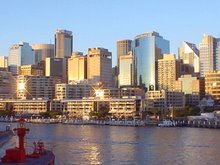
Here's a last morning's view of Sydney. Really a great city.


Cheers,

Rob